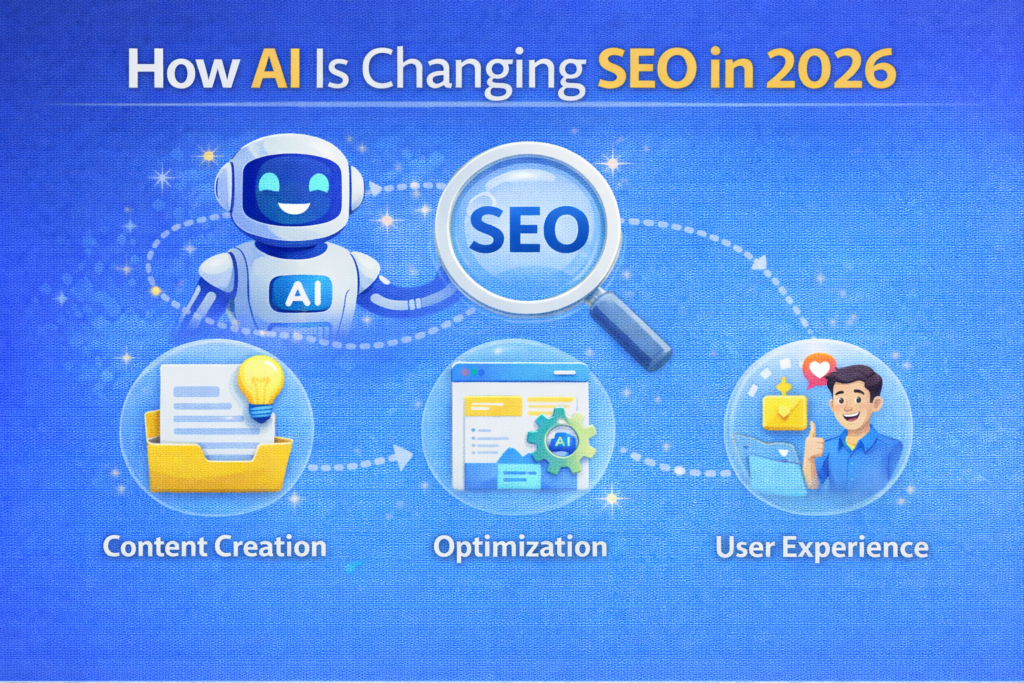
Search engine optimization is no longer just about keywords, backlinks, and rankings. In 2026, artificial intelligence (AI) is reshaping how search engines understand content, how users discover information, and how businesses earn visibility online. From Google’s AI Overviews to AI-powered content tools and conversational search, SEO has entered a new phase, one where intent, context, and authority matter more than ever. This guide explains exactly how AI is changing SEO in 2026 and what you need to do to stay competitive.
Introduction: How AI Is Redefining SEO in 2026
Search engines are no longer just indexing pages, they’re interpreting meaning. AI now plays a central role in ranking content, generating answers, and deciding which sources are trustworthy enough to be cited. As a result, SEO strategies that worked a few years ago, like keyword stuffing or surface-level content—are losing effectiveness. Modern SEO requires a deeper understanding of user intent, semantic relevance, and AI-driven search behavior.
What Is AI SEO?
AI SEO refers to the use of artificial intelligence technologies, such as machine learning, natural language processing (NLP), and large language models to improve how websites are optimized for search. Unlike traditional SEO, which relies heavily on static rules and manual analysis, AI SEO enables:
- Smarter keyword research based on intent
- Automated content analysis and optimization
- Predictive insights into ranking changes
- Real-time performance monitoring
In short, AI SEO shifts optimization from a reactive process to a continuous, adaptive strategy.
Why AI SEO Matters More Than Ever in 2026
Search behavior has fundamentally changed. Users now get answers from:
- Google AI Overviews
- Featured snippets
- Voice assistants
- AI chatbots like ChatGPT and Gemini
This rise in zero-click searches means users often get answers without visiting a website. As a result, ranking alone is no longer enough, your content must be clear, authoritative, and structured so AI systems can confidently surface it. AI SEO matters because it helps you:
- Stay visible across AI-powered search experiences
- Match content to real user intent
- Adapt quickly to algorithm and SERP changes
Evolution of SEO: From Keywords to Search Intent
Traditional SEO vs AI-Driven SEO
Traditional SEO focused on:
- Exact-match keywords
- Keyword density
- Manual backlink building
AI-driven SEO focuses on:
- Meaning and context
- Search intent and behavior
- Topic depth and authority
Search engines now evaluate whether content solves a problem, not just whether it contains a keyword.
How Search Engines Use AI Today Modern search relies on advanced AI systems such as:
- RankBrain, which interprets unfamiliar queries
- BERT, which understands language context
- AI Overviews, which generate summarized answers from multiple sources
These systems reward content that is well-structured, comprehensive, and aligned with how humans naturally search.
Core Components of AI-Powered SEO
AI-Driven Keyword Research
AI tools go beyond search volume. They analyze:
- Emerging trends
- Semantic relationships
- Long-tail and conversational queries
This helps you target keywords based on intent, not just popularity.
AI Content Creation & Optimization
AI assists with:
- Content outlines
- Topic coverage analysis
- Readability improvements
- Semantic enrichment
However, AI works best when paired with human expertise, originality, and real-world insight.
AI for Technical SEO
AI improves technical SEO by:
- Detecting crawl issues faster
- Predicting the impact of fixes
- Automating schema markup
- Optimizing internal linking structures
AI-Based Performance Monitoring
Instead of manual reporting, AI systems:
- Detect ranking anomalies
- Explain performance changes
- Alert you to issues in real time
AI Search & SERP Visibility
AI SEO also focuses on:
- Featured snippets
- Question-based queries
- Entity clarity
- Visibility in AI-generated responses
Generative Engine Optimization (GEO): The New SEO Layer
Generative Engine Optimization (GEO) focuses on optimizing content so it can be cited or referenced by AI-generated answers. While traditional SEO aims to rank pages, GEO aims to:
- Be quoted by AI systems
- Appear as a trusted source
- Influence AI summaries
This requires clear answers, structured formatting, and strong authority signals.
How AI Is Changing Content Strategy in SEO
AI has raised the bar for content quality. Thin, repetitive content struggles to perform, while expert-driven, intent-focused content stands out. Winning content in 2026:
- Answers questions clearly and early
- Uses natural language
- Covers topics comprehensively
- Demonstrates experience and expertise
AI can support the process, but human judgment remains essential.
Best Practices to Optimize for AI SEO in 2026
Key strategies include:
- Structured content with clear headings
- Schema markup to define context and entities
- Long-tail and conversational queries
- Regular content updates for freshness
- Strong internal linking for topical authority
These practices help both users and AI systems understand your content better.
Tools Powering AI SEO in 2026
AI Content & Optimization Tools
- MarketMuse
- Clearscope
- Frase
- Semrush Content Tools
AI Keyword & SERP Analysis Tools
- Semrush Keyword Magic Tool
- BrightEdge
- Conductor
AI Technical SEO & Monitoring Tools
- Screaming Frog
- ContentKing
- Botify
- Lumar
These tools help scale SEO efforts without sacrificing accuracy.
Benefits of Using AI for SEO
AI-driven SEO delivers clear advantages:
- Efficiency: Automates time-consuming tasks
- Accuracy: Reduces guesswork with data-driven insights
- Adaptability: Responds quickly to algorithm changes
- Scalability: Enables optimization at enterprise level
Challenges & Limitations of AI SEO
Despite its benefits, AI SEO has limitations:
- Over-reliance on AI can reduce originality
- AI-generated content may lack depth
- Human oversight is still required for accuracy and trust
The best results come from combining AI tools with human expertise.
The Future of SEO in an AI-Driven Search Landscape
SEO in the future will focus less on manipulation and more on:
- Helping users
- Demonstrating real expertise
- Building trusted brands
- Creating content AI systems can confidently reference
SEO professionals who adapt early will gain a strong competitive edge.
Making SEO Work with AI, Not Against It
AI is not replacing SEO, it’s evolving it. Success in 2026 depends on understanding how AI evaluates content and aligning your strategy accordingly. By focusing on intent, structure, authority, and user value, you can ensure your SEO efforts remain effective in an AI-powered search world.